Physics Digital Textbook
Modern Physics ยท Chapter

Special Relativity

Explore how time, distance, simultaneity, and speed behave when everyday assumptions no longer hold.

Start chapter

Learning Path

Checkpoint 1: Spacetime diagrams

Events, Frames and Simultaneity

Use spacetime diagrams to compare observers, event ordering, and the meaning of simultaneity.

Checkpoint 2: Quantum probability

Probability Models in Modern Physics

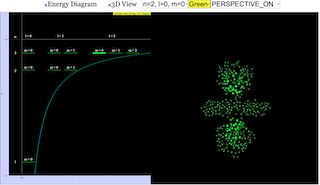
Use the hydrogen probability-density models as a companion modern-physics visualisation of non-classical descriptions.

Chapter Lens

How do spacetime diagrams help us reason about events when everyday ideas of simultaneity and time are no longer enough?

  • An event is described by where and when it happens, so spacetime diagrams combine position and time.
  • Observers in different frames can disagree about simultaneity while still describing the same physical events consistently.
  • Modern physics often requires visual models because intuition built from everyday speeds can mislead us.

Misconception Watch

  • A spacetime diagram is not just a normal position graph; one axis represents time.
  • Different observers can disagree about simultaneity without one observer simply being wrong.
  • Probability density is not a photograph of an electron path; it represents likelihood of detection.

Chapter Concept Checks

1. What does a single point on a spacetime diagram usually represent?

Answer: An event with both a position and a time.

Distractors to watch for: Only a place with no time. / Only a clock with no position. / A force arrow.

2. Why can simultaneity be difficult in special relativity?

Answer: Different inertial observers may slice spacetime into 'now' differently.

Distractors to watch for: Because clocks cannot ever be compared. / Because light has no speed. / Because all events must happen at the same place.

3. Why are probability-density visualisations useful in modern physics?

Answer: They show where a quantum object is more likely to be detected rather than a fixed classical path.

Distractors to watch for: They prove electrons are tiny planets on exact visible tracks. / They replace all measurements with guesses. / They show that atoms have no structure.

Starter Set

Begin with one strong interactive from each strand before browsing the full chapter.

Simultaneity Spacetime Diagram thumbnail Spacetime diagrams

Simultaneity Spacetime Diagram

Explore Simultaneity Spacetime Diagram as an interactive EJS simulation for modern physics.

Study Spacetime diagrams
Hydrogen Atom Probability Densitites thumbnail Quantum probability

Hydrogen Atom Probability Densitites

Explore Hydrogen Atom Probability Densitites as an interactive EJS simulation for modern physics.

Study Quantum probability

Adaptive Suggestion

If this chapter feels hard, study the first few interactives and use the concept checks until your streak improves. If it feels easy, jump to resources with videos or OSPSG links and explain the model evidence in your own words.

Back to chapter map
Simultaneity Spacetime Diagram thumbnail

1. Simultaneity Spacetime Diagram

Explore Simultaneity Spacetime Diagram as an interactive EJS simulation for modern physics.

Spacetime diagrams Interactive Resource page Quiz not attempted here yet
Study Launch
Simultaneity Spacetime Diagram thumbnail

2. Simultaneity Spacetime Diagram

Explore Simultaneity Spacetime Diagram as an interactive EJS simulation for modern physics.

Spacetime diagrams Interactive Resource page Quiz not attempted here yet
Study Launch
Understanding Spacetime Diagrams thumbnail

3. Understanding Spacetime Diagrams

Explore Understanding Spacetime Diagrams as an interactive EJS simulation for modern physics.

Spacetime diagrams Interactive Resource page Quiz not attempted here yet
Study Launch
Hydrogen Atom Probability Densitites thumbnail

4. Hydrogen Atom Probability Densitites

Explore Hydrogen Atom Probability Densitites as an interactive EJS simulation for modern physics.

Quantum probability Interactive Resource page Quiz not attempted here yet
Study Launch
Hydrogen Atom (Coulomb) Probability Densitites In 3 D thumbnail

5. Hydrogen Atom (Coulomb) Probability Densitites In 3 D

Explore Hydrogen Atom (Coulomb) Probability Densitites In 3 D as an interactive EJS simulation for modern physics.

Quantum probability Interactive Resource page Quiz not attempted here yet
Study Launch
Previous: Nuclear Physics Back to textbook map