Rutherford'S Atomic Model
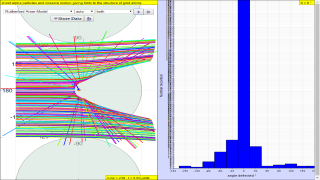
Explore Rutherford'S Atomic Model as an interactive EJS simulation for modern physics.
1. Watch or Launch
Launch the Interactive
Open the simulation, adjust the controls, and compare what changes on screen before answering the concept-check questions.
2. Big Ideas
What Students Can Learn
- Compare alpha-particle paths in the Thomson/plum-pudding and Rutherford nuclear models.
- Use scattering angle and rare backscattering as evidence, not just the atom picture.
- Relate close approaches to stronger electrostatic repulsion from the positive nucleus.
- Explain why many straight-through paths and a few large deflections can both be important.
Guiding Question
Which scattering pattern supports a small dense nucleus, and what feature of the alpha-particle paths is the evidence?
3. Try the Investigation
Choose the Atomic Model
Start with one model, such as Thomson's plum-pudding model, and observe whether alpha particles pass through, deflect slightly, or scatter through large angles.
Switch the Model
Change to the Rutherford nuclear model while keeping the comparison focused on the alpha-particle trajectories.
Compare Deflections
Look for the frequency of straight-through paths, small deflections, and rare large-angle scattering events.
Explain the Evidence
Connect large deflections to close approaches to a small positive nucleus rather than treating the atom image as the only evidence.
4. Teacher Notes
Lesson Use
Use this page as an evidence-from-trajectories lesson. Students should compare what the alpha particles do in the Thomson and Rutherford models before naming the accepted nuclear model.
Discussion Prompts
Ask: Why do most alpha particles pass through? What kind of charge distribution would produce a rare large deflection? Why is one strongly scattered particle more important than a decorative atom diagram?
Teaching Moves
Pause on a large-angle event and ask students to explain it using electrostatic repulsion and close approach. Then contrast that with the diffuse positive charge in the plum-pudding model.
Model Notes
The useful source evidence is the path display: alpha-particle trajectories, scattering angles, and model choice. Keep the focus on trajectory evidence rather than a generic statement that atoms have nuclei.
5. Concept Check
These questions are generated from the topic and the concept illustrated by the simulation. Use them after students have explored the model.
Concept Score
Correct first attempts build a streak and unlock higher point multipliers on this device.
1. What is the main value of using Rutherford'S Atomic Model as a simulation?
2. Which habit makes the investigation more reliable?
3. What should students use as evidence in their explanation?
4. Why is comparing two settings useful?
5. What is a strong final response after using the simulation?
Expert Challenge
Unlocks after 3 correct concept-check answers on this page.
1. In a Rutherford or plum-pudding model interactive, what should students compare?
2. What feedback fits 'large-angle scattering supports a diffuse positive pudding'?
3. How should students use the impact parameter in the model?
4. What should students compare between plum pudding and nuclear models?
5. What makes a Rutherford answer expert-level?
7. Learning Pulse
Anonymous activity shows this resource is being discovered, revisited, and used by learners in different places.
Where Recent Learners Are From
Country or region is inferred anonymously from server location headers when available. No names, accounts, or IP addresses are shown.