Oscillator Chain Model
Explore Oscillator Chain Model as an interactive EJS simulation for modern physics.
1. Watch or Launch
Launch the Interactive
Open the simulation, adjust the controls, and compare what changes on screen before answering the concept-check questions.
2. Big Ideas
What Students Can Learn
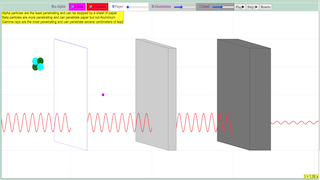
- Compare alpha, beta, and gamma transmission through the same absorber.
- Use detector count or path length as evidence for penetration.
- Change absorber material or thickness one variable at a time.
- Distinguish penetration from ionising power and from general danger.
Guiding Question
Which radiation reaches the detector after shielding, and what does that show about penetration?
3. Try the Investigation
Select a Radiation Type
Choose alpha, beta, or gamma while keeping the source and detector arrangement clear.
Add an Absorber
Insert a material or change thickness and observe whether the path or detector count changes.
Compare Radiation Types
Use the same absorber condition for another radiation type to make a fair comparison.
Rank Penetration
Use the detector evidence to rank which radiation is stopped most easily and which is most penetrating.
4. Teacher Notes
Lesson Use
Use this to replace memorised penetration tables with evidence from the model. Students should say what reaches the detector and under what absorber condition.
Discussion Prompts
Ask: Which radiation is stopped first? What does detector count show? How does changing thickness differ from changing material?
Teaching Moves
Set up a comparison table with radiation type, absorber, and detector count. Keep students from changing source, absorber, and detector position all at once.
Model Notes
The source evidence is particle path, absorber setting, and detector count. Keep the conclusion tied to the visible transmission or stopping behaviour.
5. Concept Check
These questions are generated from the topic and the concept illustrated by the simulation. Use them after students have explored the model.
Concept Score
Correct first attempts build a streak and unlock higher point multipliers on this device.
1. What does a spring force usually try to do?
2. What happens to oscillation amplitude when damping is increased?
3. In a simple spring model, what does greater extension usually produce?
4. Why identify the equilibrium position?
5. What should students use as evidence for damping?
Expert Challenge
Unlocks after 3 correct concept-check answers on this page.
1. In a particle-penetration interactive, what should students compare?
2. What feedback fits 'alpha, beta, and gamma penetrate equally'?
3. How should students test absorber thickness?
4. What should students infer if detector count falls after shielding?
5. What makes a penetration answer expert-level?
7. Learning Pulse
Anonymous activity shows this resource is being discovered, revisited, and used by learners in different places.
Where Recent Learners Are From
Country or region is inferred anonymously from server location headers when available. No names, accounts, or IP addresses are shown.