Teacher Demonstration
Use the live model as a shared screen demonstration before students try their own predictions and observations.
Explore Three State Decay Theory as an interactive EJS simulation for modern physics.
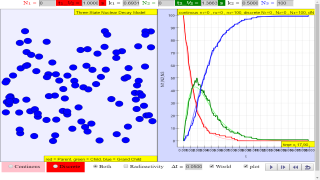
Use the live model as a shared screen demonstration before students try their own predictions and observations.
Open the simulation, adjust the controls, and compare what changes on screen before answering the concept-check questions.
How does the displayed count or activity change over time, and what does that show about half-life and random decay?
Note the initial number of nuclei, dice, or parent atoms before running the model.
Observe how many decay events occur and how many undecayed nuclei remain.
Use the graph or counts to see whether the population falls in a half-life pattern.
Compare repeated runs or dice trials to separate random individual events from the overall decay trend.
Use this as a probability-and-population lesson. Ask students to explain why individual decay is unpredictable but the population trend can still be modelled.
Ask: What halves during one half-life? Why do repeated dice runs differ? How does a larger sample make the decay curve smoother?
Have students annotate the graph at successive half-lives and describe the surviving fraction. For dice pages, compare two runs before discussing expected behaviour.
Target the displayed count, activity, graph shape, and dice/random trial mechanism. Avoid only saying 'radioactivity decreases' without time and population evidence.
These questions are generated from the topic and the concept illustrated by the simulation. Use them after students have explored the model.
Correct first attempts build a streak and unlock higher point multipliers on this device.
1. What should come with a measured value?
2. Why choose a suitable instrument?
3. What does uncertainty remind us?
4. Why repeat a measurement?
5. What is a good measurement explanation?
Unlocks after 3 correct concept-check answers on this page.
1. In a radioactive-decay interactive, what should students compare as time passes?
2. What feedback fits 'half-life means all nuclei decay exactly halfway through the run'?
3. How should students use the dice-decay model?
4. What should students check in a three-state decay model?
5. What makes a nuclear-decay answer expert-level?
Anonymous activity shows this resource is being discovered, revisited, and used by learners in different places.
Country or region is inferred anonymously from server location headers when available. No names, accounts, or IP addresses are shown.