Photoelectric Effect Simulator
Explore Photoelectric Effect Simulator as an interactive EJS simulation for electricity and magnetism.
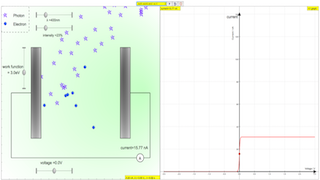
1. Watch or Launch
Launch the Interactive
Open the simulation, adjust the controls, and compare what changes on screen before answering the concept-check questions.
2. Big Ideas
What Students Can Learn
- Identify the quantum quantity represented by the model.
- Use graph, spectrum, detector, probability, or readout evidence.
- Change one control before comparing outcomes.
- Connect the observed response to the represented quantum mechanism.
Guiding Question
What displayed evidence supports the quantum explanation on this page?
3. Try the Investigation
Identify the Display
Decide whether the model is showing a spectrum, detector pattern, probability graph, energy level, or measurement result.
Change One Control
Adjust one setting linked to the displayed quantum quantity.
Read the Evidence
Compare the graph, spectrum, detector pattern, or readout before and after the change.
Explain the Quantum Link
Connect the observed change to photon energy, probability, measurement, energy levels, or wave behaviour as appropriate.
4. Teacher Notes
Lesson Use
Use this as a model-evidence lesson. Students should first name the representation before using quantum vocabulary.
Discussion Prompts
Ask: What is being measured or represented? What changed on screen? Which part of the display supports the claim?
Teaching Moves
Require a prediction and a display-based observation before the explanation. This keeps the page from becoming a generic concept quiz.
Model Notes
This is the general Modern Physics fallback; narrower profiles should be used when the page source identifies a specific simulation type.
5. Concept Check
These questions are generated from the topic and the concept illustrated by the simulation. Use them after students have explored the model.
Concept Score
Correct first attempts build a streak and unlock higher point multipliers on this device.
1. In an Ohm's law or resistor interactive, what should students compare?
2. For the same potential difference, what happens when resistance increases?
3. What does a straight-line V-I graph through the origin suggest for a resistor?
4. What evidence should be cited when a variable resistor is changed?
5. What makes a DC-circuit conclusion strong?
Expert Challenge
Unlocks after 3 correct concept-check answers on this page.
1. In a photoelectric-effect interactive, what should students vary first to test emission?
2. What feedback fits 'brighter low-frequency light must eject electrons'?
3. How should students interpret stopping potential in the model?
4. What graph trend should students look for when frequency changes above threshold?
5. What makes a photoelectric answer expert-level?
7. Learning Pulse
Anonymous activity shows this resource is being discovered, revisited, and used by learners in different places.
Where Recent Learners Are From
Country or region is inferred anonymously from server location headers when available. No names, accounts, or IP addresses are shown.