Teacher Demonstration
Use the live model as a shared screen demonstration before students try their own predictions and observations.
Explore Lookang as an interactive EJS simulation for mechanics.
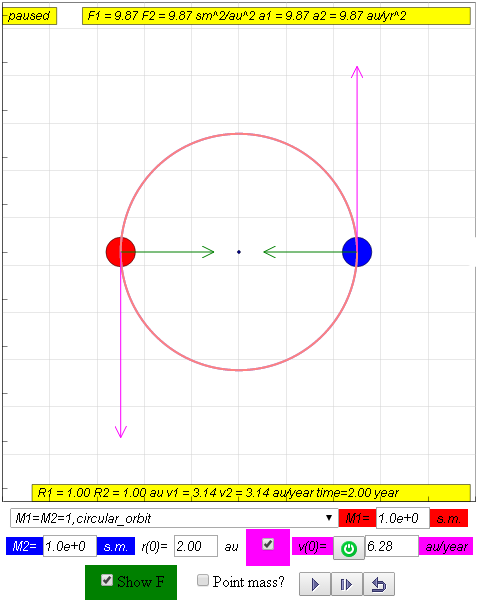
Use the live model as a shared screen demonstration before students try their own predictions and observations.
Open the simulation, adjust the controls, and compare what changes on screen before answering the concept-check questions.
What stays the same for the system during the collision, and what may change?
Note the masses and velocities before contact.
Run the interaction and identify whether objects bounce, stop, or move together.
Compare total momentum before and after, then check whether kinetic energy also stays the same.
Classify the collision and support your choice with momentum and motion evidence.
Use the model to separate conservation of momentum from conservation of kinetic energy.
Ask: Whose momentum changed? What happened to total momentum? Was kinetic energy conserved?
Make students compare system totals before discussing individual objects.
These questions are generated from the topic and the concept illustrated by the simulation. Use them after students have explored the model.
Correct first attempts build a streak and unlock higher point multipliers on this device.
1. What quantity is conserved in an isolated collision system?
2. In a perfectly inelastic collision, what do the objects do after impact?
3. What does impulse equal?
4. Why compare before-and-after totals?
5. What may change in an inelastic collision even when momentum is conserved?
Unlocks after 3 correct concept-check answers on this page.
1. In a gravity interactive, what is the best expert move before applying a formula?
2. What feedback fits 'farther away means no gravity at all'?
3. If the model lets students change mass, what comparison is most useful?
4. What is the expert correction for 'heavier objects fall faster because gravity is stronger on them'?
5. What makes a gravity explanation expert-level?
Anonymous activity shows this resource is being discovered, revisited, and used by learners in different places.
Country or region is inferred anonymously from server location headers when available. No names, accounts, or IP addresses are shown.