Teacher Demonstration
Use the live model as a shared screen demonstration before students try their own predictions and observations.
Explore Javelin Flight Dynamics as an interactive EJS simulation for mechanics.
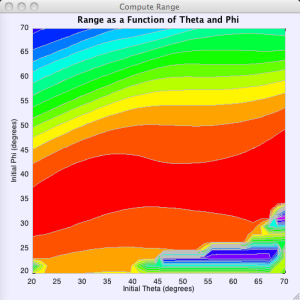
Use the live model as a shared screen demonstration before students try their own predictions and observations.
Open the simulation, adjust the controls, and compare what changes on screen before answering the concept-check questions.
When does the object stop accelerating even though it is still moving?
Observe the motion when air resistance is small or absent.
Change drag-related settings such as speed, area, or coefficient if available.
Use the velocity or acceleration display to find when acceleration approaches zero.
Connect terminal velocity to drag balancing the driving force or weight.
Use this to challenge the idea that a moving object must have a resultant force in the direction of motion.
Ask: Why can velocity be non-zero when acceleration is zero? What force grows with speed?
Have students describe forces first, then motion, so terminal velocity becomes a force-balance idea.
These questions are generated from the topic and the concept illustrated by the simulation. Use them after students have explored the model.
Correct first attempts build a streak and unlock higher point multipliers on this device.
1. What direction does air resistance act on a moving object?
2. What is terminal velocity?
3. Why can drag increase during a fall?
4. At terminal velocity, what is the acceleration?
5. Why compare with and without air resistance?
Unlocks after 3 correct concept-check answers on this page.
1. A falling object reaches terminal velocity. What is true at that instant?
2. Why does drag often increase as speed increases?
3. A student says constant velocity means no forces act. What is the best correction for terminal velocity?
4. Why compare motion with and without air resistance?
5. What happens to acceleration during a fall as drag grows toward the weight?
Anonymous activity shows this resource is being discovered, revisited, and used by learners in different places.
Country or region is inferred anonymously from server location headers when available. No names, accounts, or IP addresses are shown.