Teacher Demonstration
Use the live model as a shared screen demonstration before students try their own predictions and observations.
Analyse One Dimension Collision JS Model as a Tracker video-analysis activity for collisions, comparing before-and-after velocities and momentum evidence.
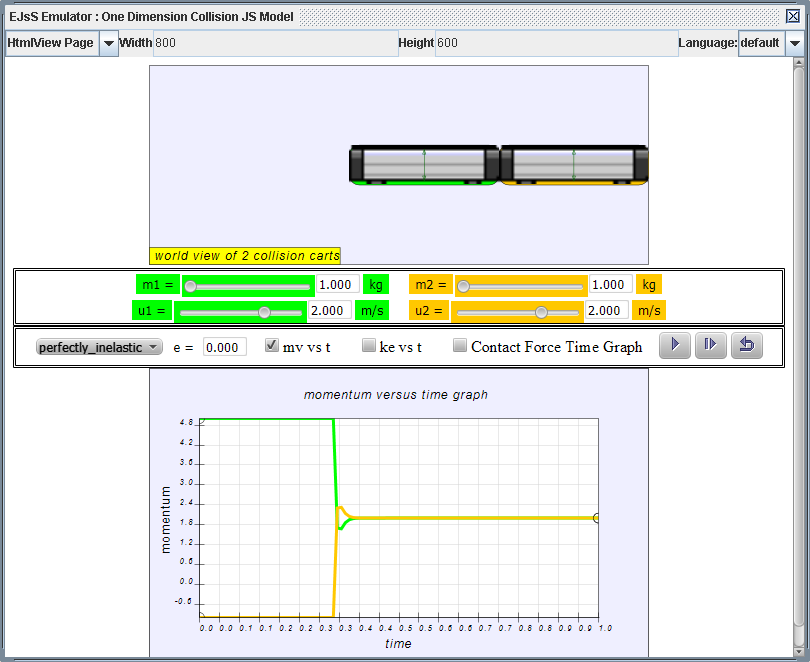
Use the live model as a shared screen demonstration before students try their own predictions and observations.
Open the simulation, adjust the controls, and compare what changes on screen before answering the concept-check questions.
What changed for each object during contact, and what system quantity should be compared before and after?
Decide which objects belong in the collision system.
Use frames just before contact to estimate each object's velocity.
Use frames just after contact to estimate new velocities and directions.
Discuss total momentum and note whether kinetic energy appears to be conserved or dissipated.
Use this as a data-based collision discussion rather than only a visual replay. Students should compare before-and-after velocities for each object.
Ask: Which object changed velocity more? Did the objects bounce, separate, or move together? What does that suggest about impulse and energy?
Have students draw a before-contact and after-contact velocity diagram before making any conservation claim.
These questions are generated from the topic and the concept illustrated by the simulation. Use them after students have explored the model.
Correct first attempts build a streak and unlock higher point multipliers on this device.
1. What is the key evidence in a collision video?
2. What system quantity is usually compared for an isolated collision?
3. What does impulse cause during contact?
4. Why use frames close to contact?
5. What should a strong conclusion include?
Unlocks after 3 correct concept-check answers on this page.
1. A student says distance and displacement are the same because both use metres. What is the best feedback?
2. An object returns to its starting point after a trip. What can be true?
3. What is the best way to distinguish speed from velocity?
4. A graph shows position changing faster and faster. What should the learner infer first?
5. What makes a kinematics explanation strong before discussing forces?
Anonymous activity shows this resource is being discovered, revisited, and used by learners in different places.
Country or region is inferred anonymously from server location headers when available. No names, accounts, or IP addresses are shown.