Teacher Demonstration
Use the live model as a shared screen demonstration before students try their own predictions and observations.
Explore For Teacher as an interactive EJS simulation for Measurement.
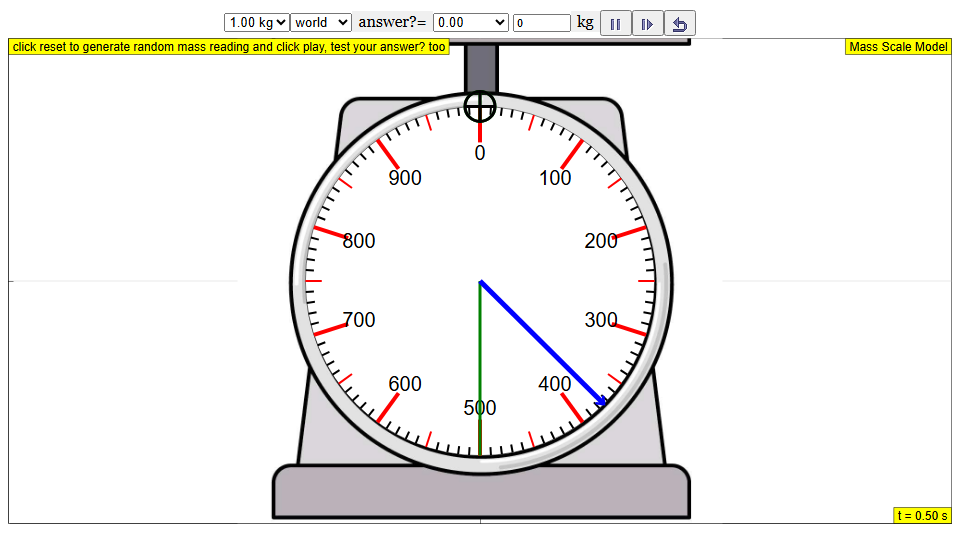
Use the live model as a shared screen demonstration before students try their own predictions and observations.
Open the simulation, adjust the controls, and compare what changes on screen before answering the concept-check questions.
How do spring stiffness and damping change the motion after the object is displaced?
Move the object away from equilibrium and predict the restoring direction.
Compare the motion for a weaker and stronger spring.
Increase damping and observe how the amplitude changes over time.
Use the motion pattern to explain how damping affects mechanical energy.
Use the model to connect force laws to time-dependent motion.
Ask: Where is equilibrium? Which direction is the restoring force? What does damping change?
Ask students to sketch force direction at several positions before running the model.
These questions are generated from the topic and the concept illustrated by the simulation. Use them after students have explored the model.
Correct first attempts build a streak and unlock higher point multipliers on this device.
1. What does a spring force usually try to do?
2. What happens to oscillation amplitude when damping is increased?
3. In a simple spring model, what does greater extension usually produce?
4. Why identify the equilibrium position?
5. What should students use as evidence for damping?
Unlocks after 3 correct concept-check answers on this page.
1. A balance gives 10.42 g, 10.43 g, and 10.42 g for a 10.00 g standard. What is the best diagnosis?
2. A ruler has a zero mark worn away and every length is read 2 mm too large. What improvement targets the main problem?
3. Which evidence best separates random error from systematic error?
4. A set of readings has a small range but its mean is far from the accepted value. Which statement is strongest?
5. Which change is most likely to improve precision rather than accuracy?
Anonymous activity shows this resource is being discovered, revisited, and used by learners in different places.
Country or region is inferred anonymously from server location headers when available. No names, accounts, or IP addresses are shown.